Simplex noise is a simple and fast alternative to Perlin noise that scales easily to arbitray dimensions. In this post I present a an implementation for 2, 3 and 4 dimensions
Simplex Noise
as of 22/4/2013 osl supports simplex noise natively, albeit for dimensions up to 4 only and without advection. This means that the code presented here and other articles on this blog stays relevant even when Blender incorporates this new OSL version but by then it probably would make sense to use the built-in simplex noise for 3 and 4 dimensions.
Simplex Noise is a simpler and faster alternative the the ubiquitous Perlin noise (Blender calls it simply 'noise'in OSL). It was designed by Ken Perlin a decade ago and a
nice article by Stefan Gustavson on the details and possible implementation is a good starter if you want to know more. In this post I present a port to OSL that is a more or less straight reimplementation of his java code.
The sampler above shows (from left to right) 2, 3 and 4D noise on a flat square and a sphere. The animated gif shows a short sequence of 4D noise (click to play from my site, Blogger doesn't show animated gifs).
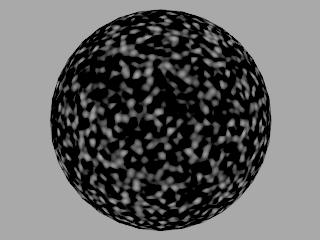
The code is quite long, but well commented. I retained most of the comments from Stefans Java code as they explain rather well what is going on. To port the code pretty much all I needed to do was replace doubles by floats and to write a shader with some functions (OSL isn't object oriented so I had to seperate those out). The only difficulty was that the OSL compiler refuses to compile arrays of structs (I will investigate that further since it should be possible). Therefor, instead of defining an array of structs to represent a four dimensional gradients I split those arrays into an array of vectors and an array of floats. See the comments in the code where that is relevant. I realize that this code is quite long and especially the first part is hard to read due to the wide permutation tables so I advise to download it (click
view plain) and read it in your favorite editor. (If you use Notepad++ or Ultraedit, setting syntax highlighting to javascript or C works quite well, Blenders internal editor has native highlighting support for OSL if you give the text buffer an .osl extension but I doesn't do a nice job on this example, at least not in my revision (r53600)).
/*
* A speed-improved simplex noise algorithm for 2D, 3D and 4D in OSL.
*
* Based on example Java code by Stefan Gustavson (stegu@itn.liu.se).
* Optimisations by Peter Eastman (peastman@drizzle.stanford.edu).
* Better rank ordering method by Stefan Gustavson in 2012.
*
* This could be speeded up even further, but it's useful as it is.
*
* OSL port Michel Anders (varkenvarken) 2013-02-04
* original comment is is left in place, OSL specific comments
* are preceded by MJA
*
* This code was placed in the public domain by its original author,
* Stefan Gustavson. You may use it as you see fit, but
* attribution is appreciated.
*
*/

int fastfloor(float x) {
 int xi = (int)x;
 return x < xi ? xi-1 : xi;
}

// MJA it is safe to overload functions in OSL
// so here's some extra dot() versions
float dot(vector g, float x, float y) {
 return g[0]*x + g[1]*y; }

float dot(vector g, float x, float y, float z) {
 return g[0]*x + g[1]*y + g[2]*z; }

float dot(vector g, float t, float x, float y, float z, float w) {
 return g[0]*x + g[1]*y + g[2]*z + t*w; }

shader simplexnoise(
 point Pos = P,
 float t = 0,
 float Scale = 1,
 int Dim = 2,
 output float fac = 0
){
 vector grad3[12] = {vector(1,1,0),vector(-1,1,0),
      vector(1,-1,0),vector(-1,-1,0),
      vector(1,0,1),vector(-1,0,1),
      vector(1,0,-1),vector(-1,0,-1),
      vector(0,1,1),vector(0,-1,1),
      vector(0,1,-1),vector(0,-1,-1)};
 // MJA I couldn't get OSL to compile an array of structs so
 // I separated a vec4 into a vector and a float
 vector grad4v[32]= {vector(0,1,1) ,vector(0,1,1)  ,
      vector(0,1,-1) ,vector(0,1,-1),
      vector(0,-1,1),vector(0,-1,1) ,
      vector(0,-1,-1),vector(0,-1,-1),
      vector(1,0,1) ,vector(1,0,1)  ,
      vector(1,0,-1) ,vector(1,0,-1),
      vector(-1,0,1),vector(-1,0,1) ,
      vector(-1,0,-1),vector(-1,0,-1),
      vector(1,1,0) ,vector(1,1,0)  ,
      vector(1,-1,0) ,vector(1,-1,0),
      vector(-1,1,0),vector(-1,1,0) ,
      vector(-1,-1,0),vector(-1,-1,0),
      vector(1,1,1) ,vector(1,1,-1) ,
      vector(1,-1,1) ,vector(1,-1,-1),
      vector(-1,1,1),vector(-1,1,-1),
      vector(-1,-1,1),vector(-1,-1,-1)};
 float grad4t[32]= { 1,-1,1,-1,1,-1,1,-1,1,-1,1,-1,
      1,-1,1,-1,1,-1,1,-1,1,-1,1,-1,
      0,0,0,0,0,0,0,0};

 int perm[512] = {151,160,137,91,90,15,
 131,13,201,95,96,53,194,233,7,225,140,36,103,30,69,142,8,99,37,240,21,10,23,
 190, 6,148,247,120,234,75,0,26,197,62,94,252,219,203,117,35,11,32,57,177,33,
 88,237,149,56,87,174,20,125,136,171,168, 68,175,74,165,71,134,139,48,27,166,
 77,146,158,231,83,111,229,122,60,211,133,230,220,105,92,41,55,46,245,40,244,
 102,143,54, 65,25,63,161, 1,216,80,73,209,76,132,187,208, 89,18,169,200,196,
 135,130,116,188,159,86,164,100,109,198,173,186, 3,64,52,217,226,250,124,123,
 5,202,38,147,118,126,255,82,85,212,207,206,59,227,47,16,58,17,182,189,28,42,
 223,183,170,213,119,248,152, 2,44,154,163, 70,221,153,101,155,167, 43,172,9,
 129,22,39,253, 19,98,108,110,79,113,224,232,178,185, 112,104,218,246,97,228,
 251,34,242,193,238,210,144,12,191,179,162,241, 81,51,145,235,249,14,239,107,
 49,192,214, 31,181,199,106,157,184, 84,204,176,115,121,50,45,127, 4,150,254,
 138,236,205,93,222,114,67,29,24,72,243,141,128,195,78,66,215,61,156,180,
 151,160,137,91,90,15,
 131,13,201,95,96,53,194,233,7,225,140,36,103,30,69,142,8,99,37,240,21,10,23,
 190, 6,148,247,120,234,75,0,26,197,62,94,252,219,203,117,35,11,32,57,177,33,
 88,237,149,56,87,174,20,125,136,171,168, 68,175,74,165,71,134,139,48,27,166,
 77,146,158,231,83,111,229,122,60,211,133,230,220,105,92,41,55,46,245,40,244,
 102,143,54, 65,25,63,161, 1,216,80,73,209,76,132,187,208, 89,18,169,200,196,
 135,130,116,188,159,86,164,100,109,198,173,186, 3,64,52,217,226,250,124,123,
 5,202,38,147,118,126,255,82,85,212,207,206,59,227,47,16,58,17,182,189,28,42,
 223,183,170,213,119,248,152, 2,44,154,163, 70,221,153,101,155,167, 43,172,9,
 129,22,39,253, 19,98,108,110,79,113,224,232,178,185, 112,104,218,246,97,228,
 251,34,242,193,238,210,144,12,191,179,162,241, 81,51,145,235,249,14,239,107,
 49,192,214, 31,181,199,106,157,184, 84,204,176,115,121,50,45,127, 4,150,254,
 138,236,205,93,222,114,67,29,24,72,243,141,128,195,78,66,215,61,156,180};
 // MJA precomputing this table instead of calculating it as done in the
 // original code saves 30% running time.
 int permMod12[512] = { 7, 4, 5, 7, 6, 3, 11, 1, 9, 11, 0, 5, 2, 5, 7, 9, 8,
 0, 7, 6, 9, 10, 8, 3, 1, 0, 9, 10, 11, 10, 6, 4, 7, 0, 6, 3, 0, 2, 5, 2, 10,
 0, 3, 11, 9, 11, 11, 8, 9, 9, 9, 4, 9, 5, 8, 3, 6, 8, 5, 4, 3, 0, 8, 7, 2, 9,
 11, 2, 7, 0, 3, 10, 5, 2, 2, 3, 11, 3, 1, 2, 0, 7, 1, 2, 4, 9, 8, 5, 7, 10,
 5, 4, 4, 6, 11, 6, 5, 1, 3, 5, 1, 0, 8, 1, 5, 4, 0, 7, 4, 5, 6, 1, 8, 4, 3,
 10, 8, 8, 3, 2, 8, 4, 1, 6, 5, 6, 3, 4, 4, 1, 10, 10, 4, 3, 5, 10, 2, 3, 10,
 6, 3, 10, 1, 8, 3, 2, 11, 11, 11, 4, 10, 5, 2, 9, 4, 6, 7, 3, 2, 9, 11, 8, 8,
 2, 8, 10, 7, 10, 5, 9, 5, 11, 11, 7, 4, 9, 9, 10, 3, 1, 7, 2, 0, 2, 7, 5, 8,
 4, 10, 5, 4, 8, 2, 6, 1, 0, 11, 10, 2, 1, 10, 6, 0, 0, 11, 11, 6, 1, 9, 3, 1,
 7, 9, 2, 11, 11, 1, 0, 10, 7, 1, 7, 10, 1, 4, 0, 0, 8, 7, 1, 2, 9, 7, 4, 6, 2,
 6, 8, 1, 9, 6, 6, 7, 5, 0, 0, 3, 9, 8, 3, 6, 6, 11, 1, 0, 0, 7, 4, 5, 7, 6, 3,
 11, 1, 9, 11, 0, 5, 2, 5, 7, 9, 8, 0, 7, 6, 9, 10, 8, 3, 1, 0, 9, 10, 11, 10,
 6, 4, 7, 0, 6, 3, 0, 2, 5, 2, 10, 0, 3, 11, 9, 11, 11, 8, 9, 9, 9, 4, 9, 5, 8,
 3, 6, 8, 5, 4, 3, 0, 8, 7, 2, 9, 11, 2, 7, 0, 3, 10, 5, 2, 2, 3, 11, 3, 1, 2,
 0, 7, 1, 2, 4, 9, 8, 5, 7, 10, 5, 4, 4, 6, 11, 6, 5, 1, 3, 5, 1, 0, 8, 1, 5, 4,
 0, 7, 4, 5, 6, 1, 8, 4, 3, 10, 8, 8, 3, 2, 8, 4, 1, 6, 5, 6, 3, 4, 4, 1, 10, 10,
 4, 3, 5, 10, 2, 3, 10, 6, 3, 10, 1, 8, 3, 2, 11, 11, 11, 4, 10, 5, 2, 9, 4, 6, 7,
 3, 2, 9, 11, 8, 8, 2, 8, 10, 7, 10, 5, 9, 5, 11, 11, 7, 4, 9, 9, 10, 3, 1, 7, 2,
 0, 2, 7, 5, 8, 4, 10, 5, 4, 8, 2, 6, 1, 0, 11, 10, 2, 1, 10, 6, 0, 0, 11, 11, 6,
 1, 9, 3, 1, 7, 9, 2, 11, 11, 1, 0, 10, 7, 1, 7, 10, 1, 4, 0, 0, 8, 7, 1, 2, 9, 7,
 4, 6, 2, 6, 8, 1, 9, 6, 6, 7, 5, 0, 0, 3, 9, 8, 3, 6, 6, 11, 1, 0, 0};

 // Skewing and unskewing factors for 2, 3, and 4 dimensions
 float F2 = 0.5*(sqrt(3.0)-1.0);
 float G2 = (3.0-sqrt(3.0))/6.0;
 float F3 = 1.0/3.0;
 float G3 = 1.0/6.0;
 float F4 = (sqrt(5.0)-1.0)/4.0;
 float G4 = (5.0-sqrt(5.0))/20.0;

 if(Dim == 2){
   // 2D simplex noise
   float xin=Pos[0]*Scale, yin=Pos[1]*Scale;
   float n0, n1, n2; // Noise contributions from the three corners
   // Skew the input space to determine which simplex cell we're in
   float s = (xin+yin)*F2; // Hairy factor for 2D
   int i = fastfloor(xin+s);
   int j = fastfloor(yin+s);
   float t = (i+j)*G2;
   float X0 = i-t; // Unskew the cell origin back to (x,y) space
   float Y0 = j-t;
   float x0 = xin-X0; // The x,y distances from the cell origin
   float y0 = yin-Y0;
   // For the 2D case, the simplex shape is an equilateral triangle.
   // Determine which simplex we are in.
   int i1, j1; // Offsets for second (middle) corner of simplex in (i,j) coords
   if(x0>y0) {i1=1; j1=0;} // lower triangle, XY order: (0,0)->(1,0)->(1,1)
   else {i1=0; j1=1;}      // upper triangle, YX order: (0,0)->(0,1)->(1,1)
   // A step of (1,0) in (i,j) means a step of (1-c,-c) in (x,y), and
   // a step of (0,1) in (i,j) means a step of (-c,1-c) in (x,y), where
   // c = (3-sqrt(3))/6
   float x1 = x0 - i1 + G2; // Offsets for middle corner in (x,y) unskewed coords
   float y1 = y0 - j1 + G2;
   float x2 = x0 - 1.0 + 2.0 * G2; // Offsets for last corner in (x,y) unskewed coords
   float y2 = y0 - 1.0 + 2.0 * G2;
   // Work out the hashed gradient indices of the three simplex corners
   int ii = i & 255;
   int jj = j & 255;
   int gi0 = permMod12[ii+perm[jj]];
   int gi1 = permMod12[ii+i1+perm[jj+j1]];
   int gi2 = permMod12[ii+1+perm[jj+1]];
   // Calculate the contribution from the three corners
   float t0 = 0.5 - x0*x0-y0*y0;
   if(t0 < 0) n0 = 0.0;
   else {
   t0 *= t0;
   n0 = t0 * t0 * dot(grad3[gi0], x0, y0);  // (x,y) of grad3 used for 2D gradient
   }
   float t1 = 0.5 - x1*x1-y1*y1;
   if(t1 < 0) n1 = 0.0;
   else {
   t1 *= t1;
   n1 = t1 * t1 * dot(grad3[gi1], x1, y1);
   }
   float t2 = 0.5 - x2*x2-y2*y2;
   if(t2 < 0) n2 = 0.0;
   else {
   t2 *= t2;
   n2 = t2 * t2 * dot(grad3[gi2], x2, y2);
   }
   // Add contributions from each corner to get the final noise value.
   // The result is scaled to return values in the interval [-1,1].
   fac = 70.0 * (n0 + n1 + n2);
 } else if(Dim == 3){
  // 3D simplex noise
  float xin=Pos[0]*Scale, yin=Pos[1]*Scale, zin=Pos[2]*Scale;
  float n0, n1, n2, n3; // Noise contributions from the four corners
  // Skew the input space to determine which simplex cell we're in
  float s = (xin+yin+zin)*F3; // Very nice and simple skew factor for 3D
  int i = fastfloor(xin+s);
  int j = fastfloor(yin+s);
  int k = fastfloor(zin+s);
  float t = (i+j+k)*G3;
  float X0 = i-t; // Unskew the cell origin back to (x,y,z) space
  float Y0 = j-t;
  float Z0 = k-t;
  float x0 = xin-X0; // The x,y,z distances from the cell origin
  float y0 = yin-Y0;
  float z0 = zin-Z0;
  // For the 3D case, the simplex shape is a slightly irregular tetrahedron.
  // Determine which simplex we are in.
  int i1, j1, k1; // Offsets for second corner of simplex in (i,j,k) coords
  int i2, j2, k2; // Offsets for third corner of simplex in (i,j,k) coords
  if(x0>=y0) {
  if(y0>=z0)
   { i1=1; j1=0; k1=0; i2=1; j2=1; k2=0; } // X Y Z order
   else if(x0>=z0) { i1=1; j1=0; k1=0; i2=1; j2=0; k2=1; } // X Z Y order
   else { i1=0; j1=0; k1=1; i2=1; j2=0; k2=1; } // Z X Y order
  }
  else { // x0 < y0
  if(y0 < z0) { i1=0; j1=0; k1=1; i2=0; j2=1; k2=1; } // Z Y X order
  else if(x0 < z0) { i1=0; j1=1; k1=0; i2=0; j2=1; k2=1; } // Y Z X order
  else { i1=0; j1=1; k1=0; i2=1; j2=1; k2=0; } // Y X Z order
  }
  // A step of (1,0,0) in (i,j,k) means a step of (1-c,-c,-c) in (x,y,z),
  // a step of (0,1,0) in (i,j,k) means a step of (-c,1-c,-c) in (x,y,z), and
  // a step of (0,0,1) in (i,j,k) means a step of (-c,-c,1-c) in (x,y,z), where
  // c = 1/6.
  float x1 = x0 - i1 + G3; // Offsets for second corner in (x,y,z) coords
  float y1 = y0 - j1 + G3;
  float z1 = z0 - k1 + G3;
  float x2 = x0 - i2 + 2.0*G3; // Offsets for third corner in (x,y,z) coords
  float y2 = y0 - j2 + 2.0*G3;
  float z2 = z0 - k2 + 2.0*G3;
  float x3 = x0 - 1.0 + 3.0*G3; // Offsets for last corner in (x,y,z) coords
  float y3 = y0 - 1.0 + 3.0*G3;
  float z3 = z0 - 1.0 + 3.0*G3;
  // Work out the hashed gradient indices of the four simplex corners
  int ii = i & 255;
  int jj = j & 255;
  int kk = k & 255;
  int gi0 = permMod12[ii+perm[jj+perm[kk]]];
  int gi1 = permMod12[ii+i1+perm[jj+j1+perm[kk+k1]]];
  int gi2 = permMod12[ii+i2+perm[jj+j2+perm[kk+k2]]];
  int gi3 = permMod12[ii+1+perm[jj+1+perm[kk+1]]];
  // Calculate the contribution from the four corners
  float t0 = 0.6 - x0*x0 - y0*y0 - z0*z0;
  if(t0 < 0) n0 = 0.0;
  else {
  t0 *= t0;
  n0 = t0 * t0 * dot(grad3[gi0], x0, y0, z0);
  }
  float t1 = 0.6 - x1*x1 - y1*y1 - z1*z1;
  if(t1 < 0) n1 = 0.0;
  else {
  t1 *= t1;
  n1 = t1 * t1 * dot(grad3[gi1], x1, y1, z1);
  }
  float t2 = 0.6 - x2*x2 - y2*y2 - z2*z2;
  if(t2 < 0) n2 = 0.0;
  else {
  t2 *= t2;
  n2 = t2 * t2 * dot(grad3[gi2], x2, y2, z2);
  }
  float t3 = 0.6 - x3*x3 - y3*y3 - z3*z3;
  if(t3 < 0) n3 = 0.0;
  else {
  t3 *= t3;
  n3 = t3 * t3 * dot(grad3[gi3], x3, y3, z3);
  }
  // Add contributions from each corner to get the final noise value.
  // The result is scaled to stay just inside [-1,1]
  fac = 32.0*(n0 + n1 + n2 + n3);
 } else if ( Dim == 4 ) {
  // 4D simplex noise, better simplex rank ordering method 2012-03-09
  float x=Pos[0]*Scale, y=Pos[1]*Scale, z=Pos[3]*Scale, w=t*Scale;

  float n0, n1, n2, n3, n4; // Noise contributions from the five corners
  // Skew the (x,y,z,w) space to determine which cell of 24 simplices we're in
  float s = (x + y + z + w) * F4; // Factor for 4D skewing
  int i = fastfloor(x + s);
  int j = fastfloor(y + s);
  int k = fastfloor(z + s);
  int l = fastfloor(w + s);
  float t = (i + j + k + l) * G4; // Factor for 4D unskewing
  float X0 = i - t; // Unskew the cell origin back to (x,y,z,w) space
  float Y0 = j - t;
  float Z0 = k - t;
  float W0 = l - t;
  float x0 = x - X0;  // The x,y,z,w distances from the cell origin
  float y0 = y - Y0;
  float z0 = z - Z0;
  float w0 = w - W0;
  // For the 4D case, the simplex is a 4D shape I won't even try to describe.
  // To find out which of the 24 possible simplices we're in, we need to
  // determine the magnitude ordering of x0, y0, z0 and w0.
  // Six pair-wise comparisons are performed between each possible pair
  // of the four coordinates, and the results are used to rank the numbers.
  int rankx = 0;
  int ranky = 0;
  int rankz = 0;
  int rankw = 0;
  if(x0 > y0) rankx++; else ranky++;
  if(x0 > z0) rankx++; else rankz++;
  if(x0 > w0) rankx++; else rankw++;
  if(y0 > z0) ranky++; else rankz++;
  if(y0 > w0) ranky++; else rankw++;
  if(z0 > w0) rankz++; else rankw++;
  int i1, j1, k1, l1; // The integer offsets for the second simplex corner
  int i2, j2, k2, l2; // The integer offsets for the third simplex corner
  int i3, j3, k3, l3; // The integer offsets for the fourth simplex corner
  // simplex[c] is a 4-vector with the numbers 0, 1, 2 and 3 in some order.
  // Many values of c will never occur, since e.g. x>y>z>w makes x < z, y < w and x < w
  // impossible. Only the 24 indices which have non-zero entries make any sense.
  // We use a thresholding to set the coordinates in turn from the largest magnitude.
  // Rank 3 denotes the largest coordinate.
  i1 = rankx >= 3 ? 1 : 0;
  j1 = ranky >= 3 ? 1 : 0;
  k1 = rankz >= 3 ? 1 : 0;
  l1 = rankw >= 3 ? 1 : 0;
  // Rank 2 denotes the second largest coordinate.
  i2 = rankx >= 2 ? 1 : 0;
  j2 = ranky >= 2 ? 1 : 0;
  k2 = rankz >= 2 ? 1 : 0;
  l2 = rankw >= 2 ? 1 : 0;
  // Rank 1 denotes the second smallest coordinate.
  i3 = rankx >= 1 ? 1 : 0;
  j3 = ranky >= 1 ? 1 : 0;
  k3 = rankz >= 1 ? 1 : 0;
  l3 = rankw >= 1 ? 1 : 0;
  // The fifth corner has all coordinate offsets = 1, so no need to compute that.
  float x1 = x0 - i1 + G4; // Offsets for second corner in (x,y,z,w) coords
  float y1 = y0 - j1 + G4;
  float z1 = z0 - k1 + G4;
  float w1 = w0 - l1 + G4;
  float x2 = x0 - i2 + 2.0*G4; // Offsets for third corner in (x,y,z,w) coords
  float y2 = y0 - j2 + 2.0*G4;
  float z2 = z0 - k2 + 2.0*G4;
  float w2 = w0 - l2 + 2.0*G4;
  float x3 = x0 - i3 + 3.0*G4; // Offsets for fourth corner in (x,y,z,w) coords
  float y3 = y0 - j3 + 3.0*G4;
  float z3 = z0 - k3 + 3.0*G4;
  float w3 = w0 - l3 + 3.0*G4;
  float x4 = x0 - 1.0 + 4.0*G4; // Offsets for last corner in (x,y,z,w) coords
  float y4 = y0 - 1.0 + 4.0*G4;
  float z4 = z0 - 1.0 + 4.0*G4;
  float w4 = w0 - 1.0 + 4.0*G4;
  // Work out the hashed gradient indices of the five simplex corners
  int ii = i & 255;
  int jj = j & 255;
  int kk = k & 255;
  int ll = l & 255;
  int gi0 = perm[ii+perm[jj+perm[kk+perm[ll]]]] % 32;
  int gi1 = perm[ii+i1+perm[jj+j1+perm[kk+k1+perm[ll+l1]]]] % 32;
  int gi2 = perm[ii+i2+perm[jj+j2+perm[kk+k2+perm[ll+l2]]]] % 32;
  int gi3 = perm[ii+i3+perm[jj+j3+perm[kk+k3+perm[ll+l3]]]] % 32;
  int gi4 = perm[ii+1+perm[jj+1+perm[kk+1+perm[ll+1]]]] % 32;
  // Calculate the contribution from the five corners
  // MJA because I couldn't get OSL to compile an array of structs
  // the 4-vectors for the gradients are split into an array with
  // regular vectors (x,y,z) in grad4v and an array of floats
  // (for the w component) in grad4t
  float t0 = 0.6 - x0*x0 - y0*y0 - z0*z0 - w0*w0;
  if(t0 < 0) n0 = 0.0;
  else {
  t0 *= t0;
  n0 = t0 * t0 * dot(grad4v[gi0], grad4t[gi0], x0, y0, z0, w0);
  }
  float t1 = 0.6 - x1*x1 - y1*y1 - z1*z1 - w1*w1;
  if(t1 < 0) n1 = 0.0;
  else {
  t1 *= t1;
  n1 = t1 * t1 * dot(grad4v[gi1], grad4t[gi1], x1, y1, z1, w1);
  }
  float t2 = 0.6 - x2*x2 - y2*y2 - z2*z2 - w2*w2;
  if(t2 < 0) n2 = 0.0;
  else {
  t2 *= t2;
  n2 = t2 * t2 * dot(grad4v[gi2], grad4t[gi2], x2, y2, z2, w2);
  }
  float t3 = 0.6 - x3*x3 - y3*y3 - z3*z3 - w3*w3;
  if(t3 < 0) n3 = 0.0;
  else {
  t3 *= t3;
  n3 = t3 * t3 * dot(grad4v[gi3], grad4t[gi3], x3, y3, z3, w3);
  }
  float t4 = 0.6 - x4*x4 - y4*y4 - z4*z4 - w4*w4;
  if(t4 < 0) n4 = 0.0;
  else {
  t4 *= t4;
  n4 = t4 * t4 * dot(grad4v[gi4], grad4t[gi4], x4, y4, z4, w4);
  }
  // Sum up and scale the result to cover the range [-1,1]
  fac = 27.0 * (n0 + n1 + n2 + n3 + n4);
 }
}


